
Dubai Property Investment 2026 Is the Global Investor’s Top Choice
Overview
Why Dubai Is the Global Investor’s Top Choice in 2026
In 2025, Dubai’s real estate market smashed records. Investors from around the world poured billions into property here. According to the Dubai Land Department, the emirate recorded 270,000 transactions worth AED 917 billion that year. That’s a jump of nearly 30% in value compared to the year before. And guess what? That momentum has carried straight into 2026.
If you’re looking to invest in property abroad, Dubai is hard to beat. The numbers speak for themselves. Rental yields in Dubai range from 6% to 10%, which blows away cities like London, New York, and Singapore. Add in zero capital gains tax and zero annual property tax, and you start to see why global investors are flocking here. The Dubai real estate market analysis for 2026 confirms that foreign buyers continue to drive demand, with Indians, British, and Chinese investors leading the pack.
But here’s the thing. While the opportunity is real, the path can feel confusing. You might be wondering: Is now a good time to buy? Will prices keep rising? Which neighborhoods offer the best value? With so much information flying around, it’s easy to get overwhelmed. One source says buy now, another says wait. That uncertainty can freeze you in place and cause you to miss out on a great opportunity.

That’s exactly why we created this guide. We cut through the noise and give you trusted, data-driven insights so you can navigate the Dubai property market with confidence. Whether you’re a first-time buyer or an experienced investor, you’ll get the facts you need to make smart decisions.
For a deeper look at building wealth over time, check out our full guide on long-term real estate investment in Dubai. It covers strategies that work in today’s market.
And if you want personal advice tailored to your situation, you can connect with Ayaz Salman for a FREE Dubai Real Estate Consultation. No pressure, just straight talk from someone who knows the market inside out.
Why Dubai? The Unmatched Appeal for International Investors
So what makes Dubai stand out from every other global city when you want to invest in property abroad? It really comes down to three huge advantages that most markets simply cannot match.
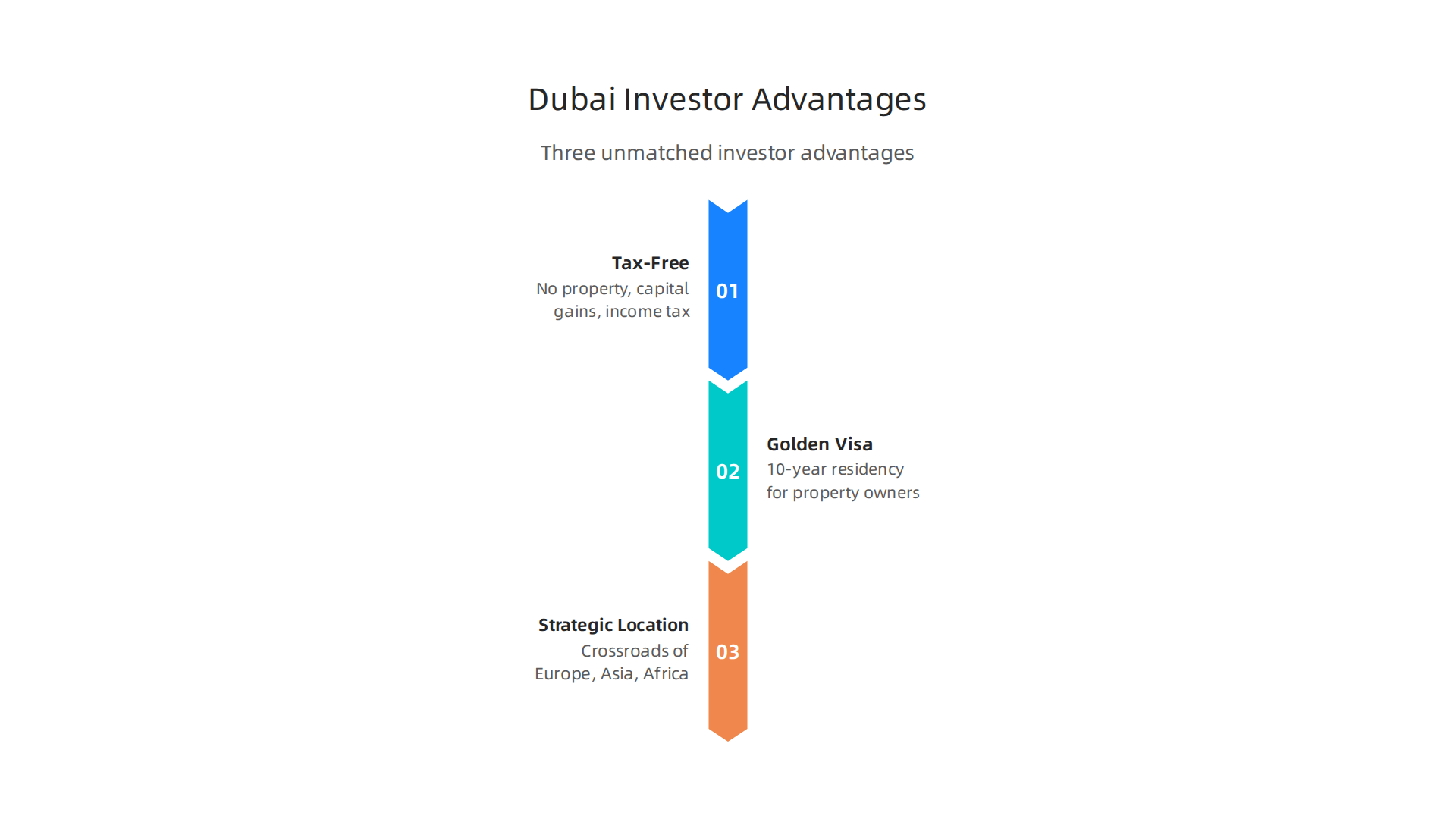
A truly tax-free environment. This is the big one. When you buy a home in Dubai, you pay zero annual property tax. When you sell it, there is zero capital gains tax. And when you rent it out, the rental income is tax-free too. That means every dirham you earn stays in your pocket. Compare that to cities like London or New York, where taxes eat into your returns every year. A recent breakdown of the Dubai property investment advantages in 2026 confirms this tax structure is a major draw for global buyers. Even Value Added Tax does not apply to residential property sales, which keeps transaction costs low.
The Golden Visa: your path to long-term residency. If you purchase property worth AED 2 million or more, you and your family can qualify for a 10-year renewable Golden Visa. This visa lets you live, work, and study in Dubai with no need for a local sponsor. It is renewable indefinitely as long as you maintain ownership. This policy has been a game-changer for international investors who want a secure base in the Middle East. Many investors use their Dubai property as both an income-producing asset and a pathway to a second home for their family.
Strategic location and world-class infrastructure. Dubai sits at the crossroads of Europe, Asia, and Africa. You can fly to half the world’s population within eight hours. The city has one of the busiest airports on the planet, a top-ranked port, and modern roads and metro systems. The infrastructure is built for growth. And the city keeps improving with new attractions, business zones, and residential communities launching every year. For anyone looking at the real estate Dubai market, this combination of location and amenities makes properties here highly desirable.
If you want to explore which neighborhoods offer the best value right now, check out our guide on the best returns on investments in Dubai 2026. It breaks down where to buy for rental income and capital growth.
Understanding the Dubai Property Market in 2026: Trends and Data
Now that you know why Dubai attracts investors, let’s dig into the actual market numbers.

The data for 2026 helps you see where the real opportunities sit.
Price trends tell a steady growth story. After a strong 2025 where property values rose year on year, early 2026 has shown a slight monthly dip but remains well above last year. According to the most recent figures in the United Arab Emirates Residential Property Market Analysis 2026, the Dubai Residential Market Sales Price Index dropped 1.76% month on month in April 2026 but still climbed 6.09% higher than the same month in 2025. That means prices are holding firm overall. Luxury villas have seen even stronger gains, with villa prices up nearly 18% year on year. For anyone looking to invest in property abroad, this kind of steady appreciation is rare in most global cities.
Supply is growing, but demand keeps up. A big question many investors ask is whether too many new homes will flood the market. The numbers show that about 120,000 new residential units are expected to be delivered in 2026, according to Fitch Ratings. That sounds like a lot. But the latest understanding from the Dubai Real Estate Market Analysis (2026) points out that actual completions are often lower, around 65,000 to 75,000 units per year historically. And the population keeps growing at over 3% annually, which creates continuous demand. The key is picking areas where supply is balanced. High demand neighborhoods like Jumeirah Village Circle and Dubai Marina remain strong choices.
Rental yields are still world class. This is where Dubai really shines compared to London, New York, or Singapore. Across popular residential zones, gross rental yields average between 6% and 8%, with some areas delivering even more. For example, Jumeirah Village Circle offers yields above 8% for studio apartments, and Dubai Silicon Oasis can hit near 9%. You can check a detailed breakdown of the best rental yields in Dubai 2026 to compare different communities. These returns are two to three times what you would earn in most Western markets, and they come with zero income tax on your rental earnings.
If you want to go deeper into which specific properties give the highest returns, our guide on best ROI investments in Dubai 2026 walks you through off-plan options and luxury picks.
Buying, selling, renting, or investing in Dubai? Connect with Ayaz Salman for a FREE Dubai Real Estate Consultation to get personalized advice on the best opportunities for your goals.
The Legal Framework: How Foreigners Can Buy Property in Dubai
If you want to invest in property abroad, Dubai is one of the easiest markets to enter. But you still need to understand the rules. The good news is that the legal system protects both buyers and sellers.
Freehold vs. Leasehold: What You Can Own
In Dubai, foreign buyers can choose between two types of ownership.
Freehold ownership gives you full rights to the property and the land it sits on. You can sell it, rent it out, or leave it to your family forever. Since 2002, the government has set aside specific zones called freehold areas where anyone from any country can buy. Some of the most popular freehold communities include Dubai Marina, Downtown Dubai, Palm Jumeirah, and Dubai Hills Estate. You can find a complete breakdown of options in the Top Freehold Areas in Dubai guide from Engel & Voelkers.
Leasehold ownership is different. You own the building or unit for a set period, usually 99 years, but the land stays with the original owner. After the lease ends, the property goes back to that owner. This option is less common for investors looking to build long-term wealth.
For a deeper look at who qualifies and what the rules are, check the Dubai Freehold Zones Guide for Foreign Buyers from Aeon Tresl.
The Step-by-Step Registration Process
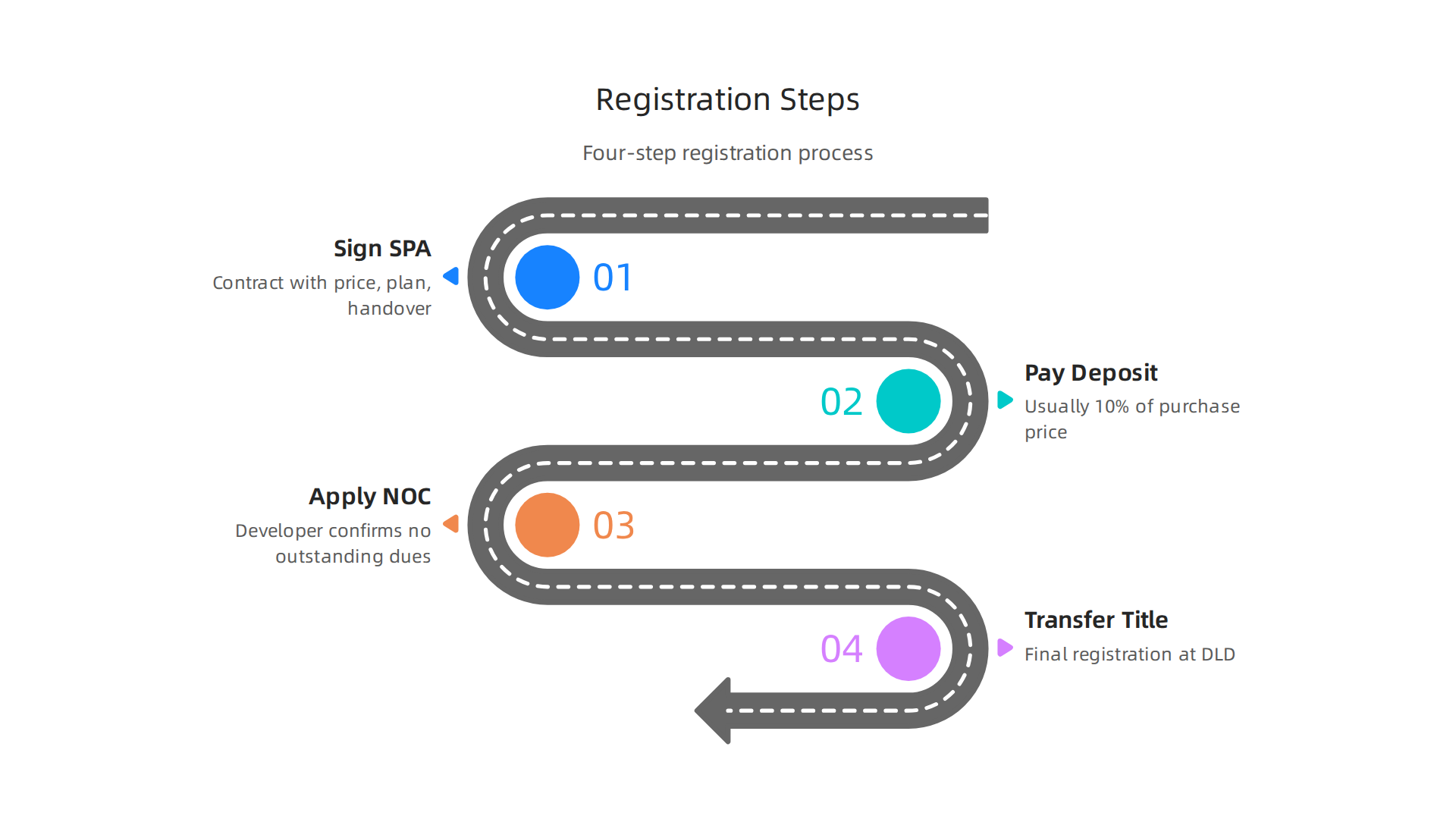
Once you find a property, the legal process is straightforward:
-
Sign a Sale Agreement (SPA). This contract lays out the price, payment plan, and handover date. Make sure you understand every clause before signing.
-
Pay the Deposit. You usually put down 10% of the purchase price to secure the unit.
-
Apply for a No Objection Certificate (NOC). The developer confirms there are no outstanding dues on the property.
-
Transfer the Title at the Dubai Land Department (DLD). This is the final step. You pay the 4% DLD fee and the property is registered in your name.
The whole process can take about two to four weeks.
Key Legal Protections for Buyers
Dubai has built strong protections to make sure your investment is safe. The Real Estate Regulatory Agency (RERA) oversees all developers and projects. Off-plan buyers benefit from escrow accounts, which hold your money until the developer meets construction milestones. Your purchase is also registered through Oqood, a system that records off-plan sales with the DLD.
Before jumping into any deal, it always helps to learn how to identify safe partners. Our guide on how to verify real estate companies in Dubai walks you through the checks that can save you from costly mistakes.
With these protections in place, you can feel confident moving forward with your property search. Next, we will look at the costs you need to budget for beyond the purchase price.
Top Investment Options: Off-Plan vs. Secondary Market
Before we look at the full list of costs, let’s talk about the two main ways to invest in property abroad in Dubai. Your choice depends on your goals, timeline, and how comfortable you are with risk.
Off-Plan: Buying Before the Building Exists
Off-plan means you buy a property while it’s still under construction. Developers sell units early stages, often at lower prices than finished homes.
Why people choose off-plan:
- Lower entry price. You often pay less per square foot than a ready property in the same area.
- Flexible payment plans. Developers let you spread payments over the construction period. You might pay only 10% upfront, then installments every few months.
- Potential capital appreciation. If the market goes up, your property could be worth more by the time it’s finished. Early buyers in areas like Dubai Hills Estate saw big gains.
But there is a catch. Off-plan projects can face delays. Completion dates sometimes slip by months or even years. You also cannot inspect the actual unit before buying. You rely on floor plans and showrooms.
Secondary Market: Ready to Move In
The secondary market means buying a completed property from its current owner. This is a ready asset.
Why investors love the secondary market:
- Immediate rental income. The day you take ownership, you can find a tenant. Dubai offers strong rental yields. According to the 2026 guide to rental property in Dubai, many communities deliver average yields of 6% to 8%, with some areas even higher.
- Full property inspection. You can walk through the home, check the quality, and see the actual view. No surprises.
- Faster transaction. You can close the deal in two to four weeks. There is no waiting for construction.
The downside? Your upfront cost is higher. You need to negotiate the price with the seller, and you usually need a larger down payment compared to off-plan payment plans.
Which One Is Right for You?
If you want a lower entry cost and don’t mind waiting, off-plan might be your path. If you need cash flow from rent right away, the secondary market wins.
Both options need careful research. For a deeper look at how these two strategies compare on returns, check our guide to investments with the best ROI in Dubai. It breaks down numbers for off-plan and ready properties.
Not sure which option fits your budget and timeline? Talk to someone who knows the market inside out. Get a FREE Dubai Real Estate Consultation with expert Ayaz Salman and get personalized advice based on your goals.
Financing Your Dubai Property Investment: Mortgages for Non-Residents
Once you have chosen between off-plan and secondary market, the next big question is how to pay for it. If you want to invest in property abroad and you are not a UAE resident, traditional mortgages are available.

But the rules are stricter.
Mortgage Eligibility: What Banks Need
Banks in Dubai will give non-residents a loan of 50% to 60% of the property value. That means you need a down payment of 40% to 50% in cash. For example, on a AED 2 million home, you put down around AED 1 million. You also need to show proof of income and prove you can afford the payments.
According to this Dubai mortgage guide for non-residents, banks typically require:
- A valid passport
- Bank statements from the last 3 to 6 months
- Tax returns for the last 2 years
- Salary slips (if salaried) or trade license (if self-employed)
- Details of any existing loans
You also need to buy in a designated freehold area. Popular spots are Dubai Marina, Downtown Dubai, Palm Jumeirah, and Business Bay.
Interest Rates: What You Will Pay
Interest rates for non-residents are higher than for residents. You can expect a premium of about 0.25% to 0.5% on top of the standard rate. In early 2026, fixed rates for non-residents range from 4.25% to 4.99% for the first 2 to 5 years. After that, the rate moves to a variable rate based on EIBOR (Emirates Interbank Offered Rate) plus a margin, which lands around 4.5% to 5.5%.
Your maximum loan term is often 15 to 25 years, and you must be under age 65 at the end of the term.
Alternative Financing: Developer Payment Plans
If a traditional mortgage feels too tight, many developers offer their own payment plans. When you buy off-plan, you can spread payments over the construction period. Some developers even offer post-handover plans, where you pay a portion after you take ownership. This can lower your upfront cash need significantly.
Another option is equity-based financing. Some investors use property equity from their home country or partner with other investors to share the purchase cost. This works best when you have a clear repayment plan.
For a deeper look at how to structure your finances for steady growth over time, read our guide on long-term real estate investment in Dubai. It covers budgeting, mortgage strategies, and exit planning for serious investors.
Maximizing Returns: Rental Yields and Capital Appreciation Strategies
You have your financing sorted, and you are ready to commit. But where should you put your money to get the best returns? When you invest in property abroad, the key is to choose a location that offers strong ongoing income and solid long-term growth. Dubai delivers on both.
Where Rental Yields Are Highest
Dubai is famous for its high rental yields. Many investors see 6% to 8% gross returns, which is far above what you get in most global capitals. For example, London averages around 4% and Paris around 3%.
Some areas stand out even more. According to our research on the best rental yields in Dubai 2026, Jumeirah Village Circle (JVC) delivers studio yields of 7.87% and one-bedroom yields of 7.04%. That is a strong cash flow for a relatively low entry price. Dubai Marina offers studio yields of 6.50%, while Business Bay sits at 6.68% for a studio. These areas are popular with tenants and maintain high occupancy rates.
If you want to push yields higher, consider smaller units. Studios and one-bedroom apartments consistently outperform larger flats in percentage terms.
What Drives Property Values Up
Rental yield is only half the picture. Capital appreciation makes the real difference over time. Dubai’s property values rise because the city keeps growing. Major infrastructure projects like Expo City (the legacy site is now a vibrant business hub) and new metro lines expand the reach of desirable neighborhoods.
Population growth is another big driver. Dubai continues to attract professionals and wealthy expats, which pushes demand for housing. The government’s economic diversification strategy into tech, finance, and tourism keeps creating high-paying jobs. This means more people with the ability to rent or buy.
These factors help protect your investment from the risk of a Dubai real estate crash. Even better, they give you the chance to sell at a profit when you exit.
Managing Your Property: DIY or Hire?
After you own the property, someone has to look after it. You have two options:
- Self-manage – You handle tenant find, maintenance, and rent collection yourself. This saves a management fee (typically 5% to 10% of annual rent) but takes time and effort. It works best if you live in Dubai or visit often.
- Hire a licensed agency – They take care of everything. You get a monthly statement and peace of mind. Management fees in Dubai range from 5% to 8% of gross rent and are tax deductible. This cuts into your net yield, but many investors find it worth the convenience.
For example, on a property with 7% gross yield, an 8% management fee reduces net yield to 6.44%. Still strong by global standards.
Summary of High-Yield Areas
| Area | Typical Gross Yield (Studio) | Why It Works |
|---|---|---|
| Jumeirah Village Circle | 7.87% | Affordable entry, strong tenant demand |
| Dubai Marina | 6.50% | Waterfront lifestyle, high occupancy |
| Business Bay | 6.68% | Central location, business district |
| Downtown Dubai | up to 7.92% | Luxury market, premium tenants |
Picking the right area and management strategy can boost your returns significantly. For expert help identifying the best property for your goals and setting up professional management, book your FREE Dubai Real Estate Consultation today. Ayaz Salman can walk you through the numbers and match you with a property that fits your budget and risk level.
Navigating Risks and Due Diligence for International Investors
The returns in Dubai are exciting, but you must protect your money. When you invest in property abroad, the smartest investors spend as much time on risk checks as they do on yield analysis. Here are the key risks to watch and how to avoid them.
Legal Risks: What You Must Verify
Dubai has strong property laws, but you need to check three things before you sign anything.
First, verify the title deed. For a completed unit, ask the seller for the official Title Deed from the Dubai Land Department (DLD). You can check it online through the Dubai REST app or the DLD website. For off-plan projects, look for Oqood registration. This is the government’s record for under-construction properties.
Second, confirm the developer is registered with RERA, the Real Estate Regulatory Agency. Only licensed developers can legally sell property in Dubai. You can check developer status and project approval on the DLD site.
Third, make sure your payments go into a RERA-approved escrow account. This protects your money if the developer runs into problems. Never pay cash outside official channels.
A complete Dubai property due diligence checklist for foreign investors covers all these steps and more.
Market Risks: Oversupply, Currency, and Downturns
No market is perfect. The Dubai real estate market can face oversupply in certain segments, especially in areas where many new projects launch at the same time. This can slow price growth and push rental yields down temporarily.
Currency risk is low because the AED is pegged to the US dollar, but global economic shifts still affect buyer demand. Some investors worry about a dubai real estate crash. While Dubai has had corrections in the past, the market today is more regulated and transparent than ever. Diversifying your portfolio across different areas and property types helps reduce risk.
Watch the dubai real estate index for overall price trends. It gives you a big-picture view of where the market is heading.
Fraud Prevention: Tools and People You Can Trust
Fraud happens when buyers skip the basics. Always work with a broker registered with RERA. You can check their license number on the DLD website.
Use DLD’s Makani system to verify property location and details. Use the Trakheesi platform to check transaction history and ownership records. These tools are free and available online.
Avoid cash payments outside official channels. Every payment should go through the escrow account or a recognized payment gateway.
Before you buy, read our guide on red flags to watch before buying property in 2026 to spot common scams and pitfalls.
Taking these steps protects your investment and gives you peace of mind. The extra time you spend on due diligence now can save you from major losses later.
Step-by-Step Guide to Your First International Investment in Dubai
You know the risks now you are ready to take action. Follow these three steps to invest in property abroad for the first time in Dubai.
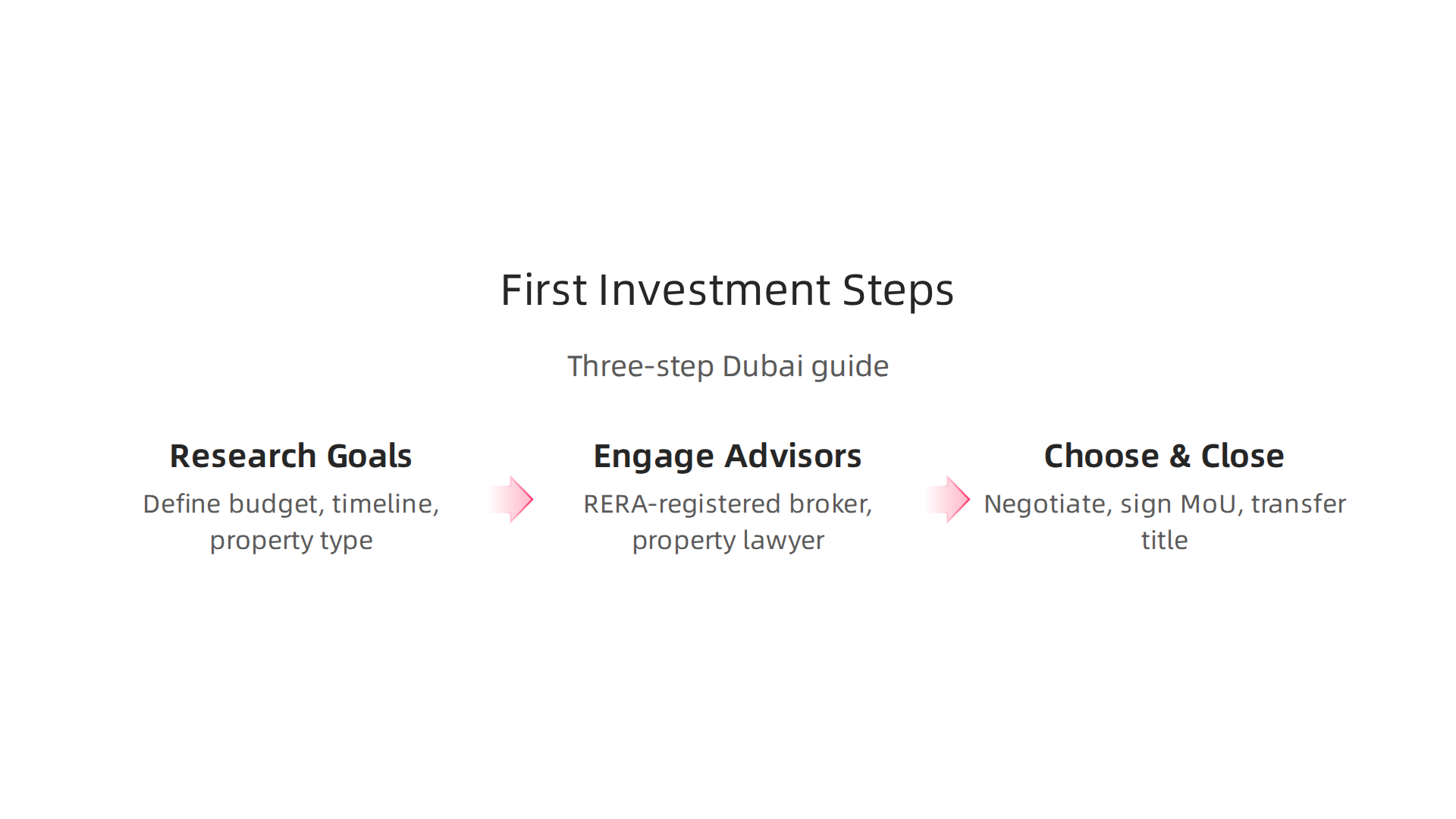
Step 1: Research and Define Your Goals
Start with your main goal. Do you want steady rental income each year? Or do you prefer long-term price growth? Both are valid, but they point you to different property types.
Set a clear budget including the 4% DLD fee and other closing costs. Also decide your timeline. Are you buying ready property for immediate rent, or off-plan for delivery in 2026 or later?
Check the dubai real estate index to understand price trends across the market. Then narrow your search to specific areas. The best areas to invest in Dubai guide breaks down top communities like Dubai Marina and JVC for different strategies.
Step 2: Engage a Trusted Local Advisor and Legal Counsel
You need experts on the ground in Dubai. Work with a RERA-registered broker and a lawyer who knows Dubai property law. Your lawyer should review every document before you sign.
Ask the broker for their RERA license number. Verify it on the DLD website. A good advisor saves you from costly mistakes. For more on this, check our guide on how to verify real estate companies in Dubai.
Step 3: Choose, Negotiate, and Close the Deal
Once you find a property you like, negotiate the price. Your broker can help with market comparisons.
When you agree on price, you sign a Memorandum of Understanding (MoU). Then pay a deposit usually 10% of the price. This deposit goes into a RERA-approved escrow account.
Finally, your lawyer handles the Sales and Purchase Agreement (SPA) and registers the transfer with DLD.

You pay the remaining amount and receive the Title Deed in your name. The whole process takes around 4 to 6 weeks.
If you want personal guidance through these steps, connect with Ayaz Salman for a FREE Dubai Real Estate Consultation. He can walk you through each stage and answer your specific questions.
Summary
This article explains why Dubai is a top choice for international property investors in 2026, showing the data, rules and practical steps you need to act with confidence. It covers record transaction volumes and strong rental yields (typically 6–10%), Dubai’s tax advantages and the AED 2 million Golden Visa pathway, plus current price and supply trends for 2026. You’ll learn the difference between freehold and leasehold, the pros and cons of off‑plan versus ready properties, and how mortgages for non‑residents work. The guide also walks through legal protections (RERA, escrow, Oqood), common risks like oversupply and developer delays, and a simple step‑by‑step buying checklist. After reading, you’ll know where to look for high yields, how to run due diligence, what financing to expect, and how to close a deal safely.