

Dubai Property Bubble Risk in 2026 A Reality Check
Overview
Introduction
Dubai’s property market has always moved in cycles. You have seen periods where prices shoot up fast, followed by times when everything slows down or even pulls back. That history naturally makes people worry about the dubai property bubble risk. Is another big correction coming? Or is this time different?
In 2026, the market looks quite different from past peaks. Population growth, changes in visa rules, and more careful regulation have helped create a more stable foundation. According to the Dubai Housing Market 2026 overview from Engel & Völkers, the city’s population surpassed 4 million in 2025, and another 175,000 to 225,000 residents are expected to arrive in 2026. This steady flow of new people supports housing demand in a way that short-term speculation never could.
Still, you cannot ignore the signs that make people cautious. A large number of new homes is scheduled for completion in the next few years. Some analysts point out that if too much supply hits the market at once, prices in certain areas could soften. The question is whether that adds up to a true bubble or just a healthy adjustment.
This article brings together historical data, current market indicators, and expert forecasts to give you a clear answer. We will look at what is really happening with prices, how much new supply is coming, and what factors could trigger a downturn. We will also help you find the real estate values website and tools you need to make smart decisions.
If you want to see how different property types perform, check out our guide to best returns on investments in Dubai for 2026. It breaks down which areas still offer strong growth potential.
By the end, you will know whether the risk is real and what steps you can take to protect your money. Buying, selling, renting, or investing in Dubai? Connect with Ayaz Salman for a FREE Dubai Real Estate Consultation to get personalized advice for your situation.
What Defines a Property Bubble? Key Indicators
Before we can judge the dubai property bubble risk, we need to understand what a property bubble actually looks like.
A bubble forms when prices rise far beyond what the properties are truly worth. These gains are powered by speculation instead of real demand. People buy because they think prices will keep going up fast, not because they need a home.
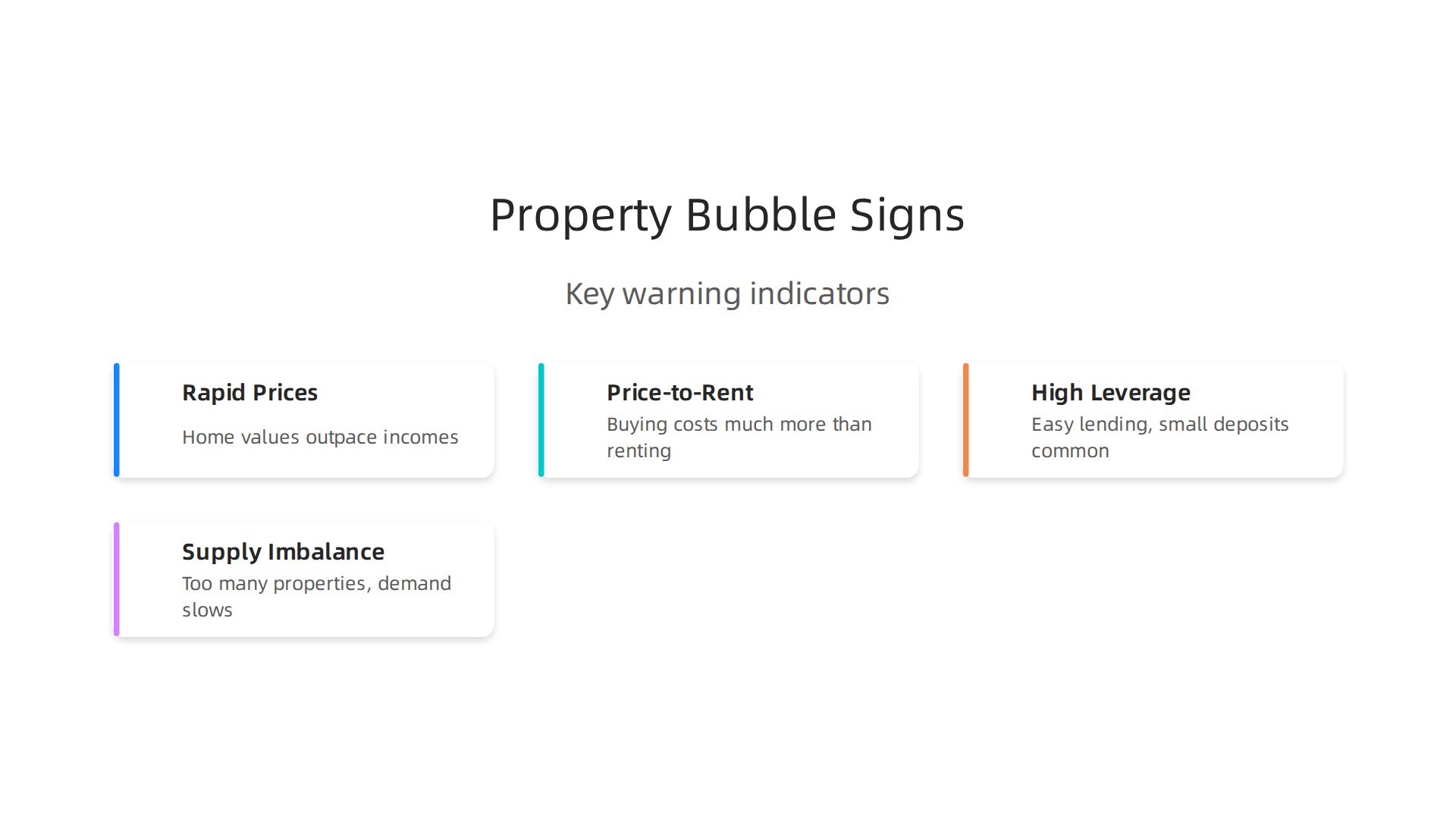
So what are the warning signs? Here are the most common indicators experts watch for:
Rapid price acceleration. When home values shoot up much faster than people’s incomes or rents, it is a red flag. During the 2008 crash, speculation drove prices to unsustainable highs. As the Wikipedia entry on the Dubai housing crash in 2009 explains, many investors bought off-plan just to flip the property quickly. That kind of buying is often a sign of a bubble forming.
High price-to-rent ratio. If buying a home costs many times more than renting a similar one, it suggests prices are inflated. Rents reflect real demand from people who actually live there. Prices should not be too far above rents for long.
Excessive credit and leverage. When banks lend very easily and buyers put down small deposits, the market becomes fragile. In 2008, mortgages with 90 to 95 percent loan-to-value ratios were normal. That left little room if prices dropped. Today, regulations have tightened, but it is still something to watch.
Supply-demand imbalance. Too many new properties being built while demand slows down can cause prices to fall sharply. That was a huge factor in the 2009 crash.
The UBS Global Real Estate Bubble Index 2025 lists Dubai as having an elevated bubble risk. That does not mean a crash is certain. It means the indicators need watching.
Before you make a move, it helps to check the facts yourself. Use a reliable real estate values website to compare prices and trends. Also, review the list of 10 UAE property purchase red flags to watch before buying in 2026 to spot warning signs early.
If you are worried about the market and want personalized guidance, you are not alone. Buying, selling, renting, or investing in Dubai? Connect with Ayaz Salman for a FREE Dubai Real Estate Consultation to get advice that fits your situation.
Dubai’s Historical Price Corrections: Lessons from 2008 and 2014
Looking at history is one of the best ways to understand the dubai property bubble risk. Dubai has faced two major downturns since opening its property market to foreign buyers. Each one taught important lessons that still apply in 2026.
The 2008-2009 crash. Prices fell by about 50 percent in many areas. An eyewitness analysis of the 2008 Dubai property crash explains that speculative buying, easy credit, and a weak regulatory framework created a fragile market. When the global financial crisis hit, capital fled and expatriates lost jobs. The recovery was strong, though. Prices rebounded by roughly 100 percent from the lows between 2010 and 2014.
The 2014-2016 correction. This downturn was less dramatic but longer. Prices dropped by 30 to 40 percent over several years. The main causes were oversupply from construction after 2012, a strong U.S. dollar making Dubai property expensive for foreign buyers, lower oil prices affecting regional wealth, and a global economic slowdown. This correction showed that even without a global crisis, internal imbalances can push prices down.
The key lesson from both episodes is that the dubai property bubble risk rises when supply outpaces genuine demand and speculation dominates. Regulations have improved since 2008. The Real Estate Regulatory Authority (RERA) now enforces stricter rules on off-plan sales and escrow accounts. But the core warning remains: market cycles are normal in Dubai.
If you want to assess the current market for yourself, start with a solid market analysis for business plan in Dubai to understand supply and demand trends. Also check a real estate values website to compare prices. And keep in mind that history shows patient buyers often find the best investments for returns after a downturn.
Current Market Supply and Demand Dynamics (2026)
Now let’s look at what is actually happening in Dubai’s property market in 2026. The balance between new supply and real demand is the most important early warning sign for the dubai property bubble risk. And the data for 2026 tells a mixed story.
On the supply side, headline numbers look scary. Reports suggest more than 70,000 residential units are scheduled for delivery in 2026. But here’s the catch: actual completions always fall short. A detailed report on the Dubai property market to see slower handover in 2025–26 shows that only about 48 percent of forecasted units are expected to be completed in 2026. That means real supply hitting the market is closer to 34,000 to 35,000 units, not the frightening 70,000 number you see in the news.
This matters because Dubai’s long-term absorption rate has historically been around 35,000 to 45,000 units per year. So if only 35,000 units are actually delivered, supply and demand may stay in reasonable balance. Still, the future pipeline is heavy. Another analysis called the Dubai Residential Supply & Delivery Outlook (2025–2027) points out that 2027 will bring the highest single-year supply in over a decade, which could test the market’s limits.
On the demand side, things still look solid. Dubai’s population grew by roughly 200,000 people in 2025. However, not all of that translates to new housing demand. As one data-driven breakdown on Dubai added 200k people but only 12k rentals explains, about 55 percent of population growth relates to rental and resale properties. The rest goes into shared accommodations. Still, foreign investors continue to drive strong off-plan sales. In 2025, off-plan transactions made up about 70 percent of the market, showing that speculation remains a major force.
So is the dubai property bubble risk real in 2026? The answer is not a simple yes or no.

Actual supply is moderating, demand is holding up, and prices are not falling. But the enormous pipeline of units expected in 2027 and beyond means that risk is building. If you want to make smart decisions in this market, you need clear, unbiased guidance. That’s where getting the right help makes all the difference. For a one-on-one conversation about your situation, get your FREE Dubai real estate consultation with Ayaz Salman via WhatsApp and talk through your options before making a move.
Macroeconomic Drivers: Oil, Tourism, and Foreign Direct Investment
You might think Dubai’s property market runs on oil money. But here’s the truth: in 2026, the story is much bigger than crude prices. Dubai has worked hard to build a diverse economy. Non-oil sectors now make up most of its GDP. This shift matters a lot when you consider the dubai property bubble risk.
Tourism is one of the biggest drivers. Dubai welcomed a record number of visitors in 2025 and early 2026. More tourists mean more people see the city and think about buying a second home or investing. This steady flow supports both short-term rentals and long-term property values.
Foreign direct investment (FDI) is another powerful force. Investors from India, China, Europe, and the UK continue pouring money into Dubai real estate.

They are looking for safe places to park their capital, and Dubai offers strong returns and a stable currency pegged to the US dollar. If you want to understand how this global interest shapes the market, check out this analysis of why Dubai property investment 2026 is the global investor’s top choice.
But not everything is rosy. Global interest rates are still high in 2026, which makes mortgages more expensive and can slow down some buyer demand. And geopolitical risks are real. Tensions in the Middle East can shake investor confidence overnight. A detailed look at how these risks play out is covered in this report on Will Dubai’s Real Estate Market Crash As The Middle East War ….
Still, the fundamentals in Dubai remain strong. Non-oil GDP growth is healthy, tourism is booming, and foreign money keeps flowing in. These macro drivers create a solid foundation for property values. The real question is whether they can absorb all the new supply coming in 2027 and beyond.
Regulatory Reforms: How Dubai Protects Against Bubbles
That is where smart regulation comes in. After the painful crash in 2008, Dubai learned its lesson. It built a system that makes a dubai property bubble risk much smaller today.
The Real Estate Regulatory Agency (RERA) now watches over every off-plan sale with strict rules.
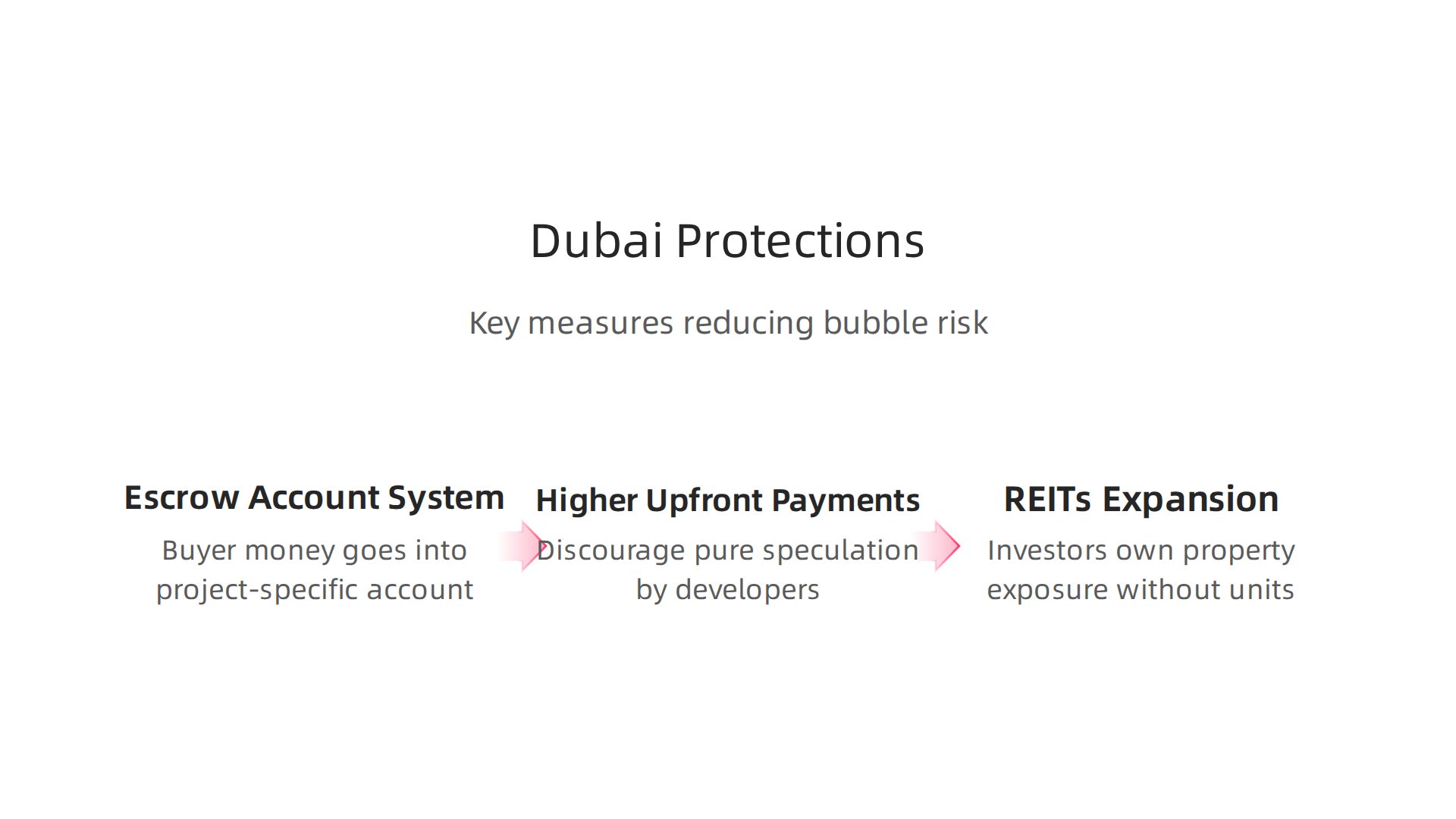
The biggest protection is the escrow account system. When you buy an off-plan property, your money does not go straight to the developer. It goes into a project-specific account overseen by RERA. The developer can only access those funds after an independent engineer confirms that construction milestones are met. If the project stalls or gets canceled, your money is protected and refunded. This system, governed by Law No. 8 of 2007, creates a safety net that did not exist before. You can read more about how this works in this guide on Escrow Account Regulations for Investors in Dubai.
Recent reforms have added another layer. Higher upfront payment requirements for off-plan purchases discourage pure speculation. Developers now need more skin in the game before they sell units. And the expansion of Real Estate Investment Trusts (REITs) gives investors a way to own property exposure without buying a whole unit. These measures help keep prices grounded. For a deeper look at what to watch before buying, check out this guide on UAE property purchase red flags to watch.
None of this makes the market bulletproof. But it creates a strong buffer. The days of handing over cash to a developer with no oversight are over. And that change makes Dubai a safer place for your money.
Buying, selling, renting, or investing in Dubai? Connect with Ayaz Salman for Free Consultation and get personalized advice on navigating the market with confidence.
Expert Forecasts and Sentiment for 2026
So the rules are solid. But what do the experts actually think? Is there still a dubai property bubble risk hanging over the market? The short answer is that opinions vary, but the data gives us a clear picture.
Leading firms like Knight Frank, CBRE, and Property Monitor keep a close eye on this market. Their forecasts for 2026 point to a market that is cooling down, not crashing. Knight Frank, for example, predicts price growth of around one percent in the mainstream market and three percent in the prime residential segment through the end of 2026. That is a far cry from the double-digit jumps of the past few years. You can see these detailed forecasts in the UAE Real Estate Market Outlook 2026 summary by Knight Frank.
The consensus among institutional analysts is that prices will rise by about three to six percent for the full year. That is a healthy moderation. It shows the market is moving from a sprint to a steady jog.
But there is a big caution signal. A wave of new supply is coming. Around 350,000 new homes are scheduled for delivery between 2026 and 2030. That is a lot of units. Some analysts worry that this flood of supply could push prices down in certain areas, especially in apartment-heavy communities. The risk is real, but it is concentrated. It is not a market-wide bubble about to pop. For a deeper look at where the best opportunities still exist, check out this guide on investments with best ROI in Dubai 2026.
Expert sentiment in 2026 is cautious but not fearful. Most believe the days of reckless speculation are behind Dubai. The regulatory safeguards combined with cooling demand mean the dubai property bubble risk is low right now. The real question is whether the market can absorb all those new homes smoothly. If you are looking for the best investments for returns, the message from analysts is clear: pick your location and developer carefully. Not every project will win.
Want to know which areas and projects have the strongest forecasts? FREE Dubai Real Estate Consultation connects you with an expert who can break down the numbers for your specific situation.
Risk Assessment: Is Dubai in a Bubble Now?
So after looking at all the expert views and market data, here is the straight answer: Dubai is not in a classic property bubble today.

But that does not mean there is zero risk. The dubai property bubble risk is low overall, but it is not gone.
Here is why the market is more solid than it looks. Dubai’s economy is more diverse now than it was before the 2008 crash. Tourism, trade, finance, and tech all support demand. Population keeps growing as people move here for work and lifestyle. And the government has built strong rules to stop runaway speculation.
One of the biggest safeguards is the escrow account system. Under Dubai Law No. 8 of 2007, every developer selling off-plan properties must put buyer payments into a secure escrow account. That money can only be released when specific construction milestones are approved. This rule protects investors and stops developers from over-leveraging. You can read more about how these escrow account regulations in Dubai keep the market safe.
Still, some parts of the market feel overheated. Luxury off-plan projects in prime areas have seen big price jumps. If global interest rates rise again, some buyers might struggle with financing. And there is the supply question too. Even if the overall market is healthy, too many new homes hitting the market at once could push prices down in certain districts.
The smart move is to treat this like a market with pockets of risk, not a bubble ready to pop. If you are looking for the best investments for returns, focus on areas where demand is real and supply is limited. Avoid chasing hype projects without checking the fundamentals.
Want to spot the warning signs before you buy? Check out this guide on UAE property purchase red flags to watch before you commit your money.
Practical Strategies to Minimize Risk
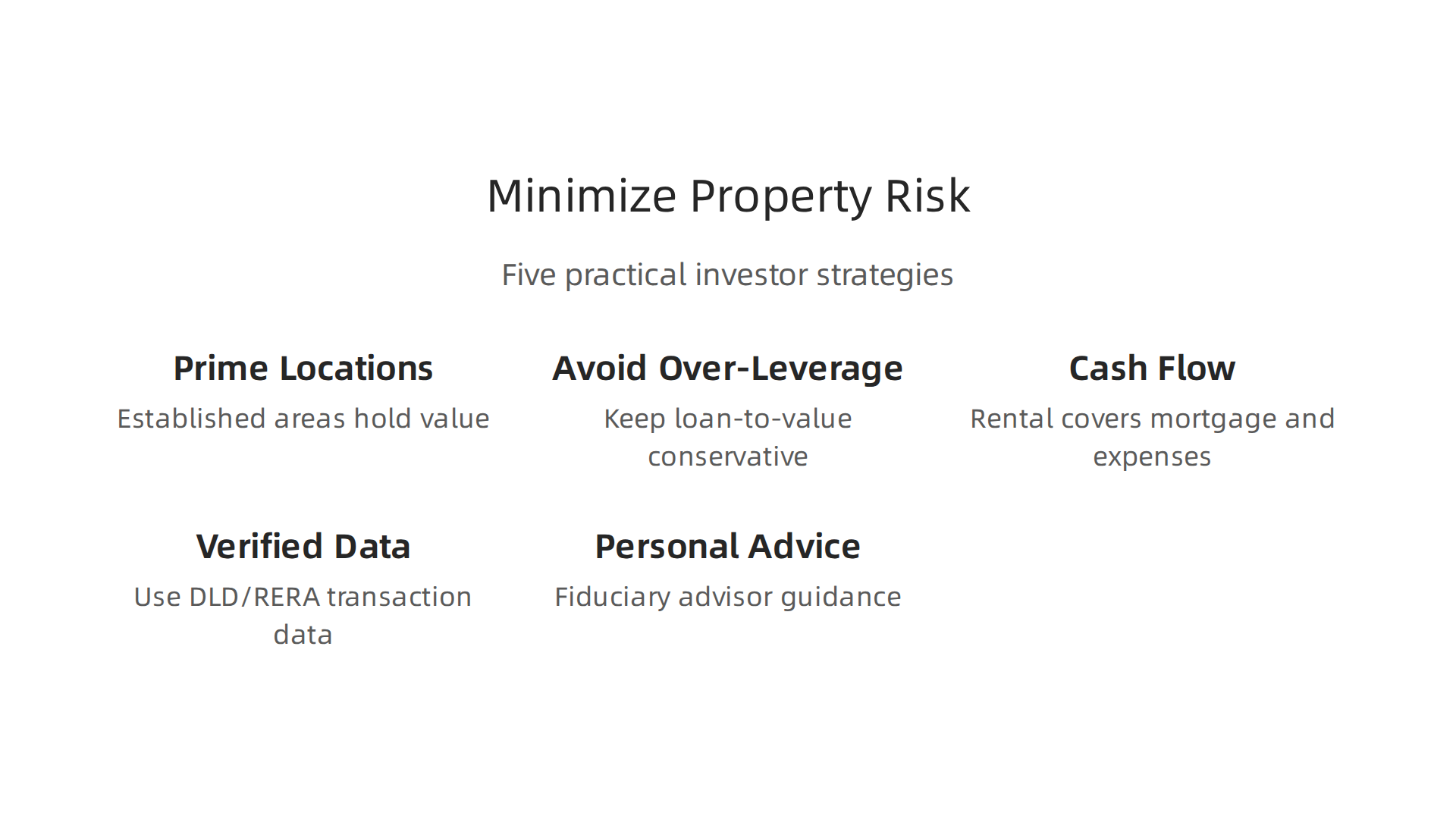
You’ve checked the data and you know the dubai property bubble risk is low but not zero. So what do you do next? The smartest investors don’t just hope for the best. They take specific steps to protect their money. Here are five practical strategies you can use right now.
1. Stick to prime locations
Properties in well-established areas like Downtown, Palm Jumeirah, and Emirates Hills tend to hold their value better during slow periods. Demand stays strong because people want to live there. Knight Frank’s 2026 Dubai real estate outlook shows prime residential prices could still grow around 3 percent in 2026, even as the overall market cools down.
2. Do not over-leverage yourself
Taking on too much debt is one of the fastest ways to lose money in real estate. If prices dip just a little, a highly leveraged property can put you underwater. Keep your loan-to-value ratio conservative. A good rule is to put down at least 30 to 40 percent if you can.
3. Focus on cash-flow positive properties
For many investors, the best investments for returns are not the ones with the biggest price jumps. They are the ones that pay you every month. A rental property that covers its own mortgage and expenses gives you a safety net. Even if values drop temporarily, you are still earning income. This is also where you can find some of the investments with best return in Dubai right now.
4. Use verified data sources
Do not rely on rumors or social media posts. The Dubai Land Department (DLD) and RERA publish official transaction data. A good real estate values website like these official portals gives you accurate numbers. You can also check trusted guides like this one on how to verify real estate companies in Dubai before you invest.
5. Get personalized advice from an expert

Every investor’s situation is different. What works for one person might be wrong for another. A fiduciary advisor looks at your goals and helps you avoid costly mistakes. If you are thinking about buying, selling, or investing in Dubai, connect with Ayaz Salman for a FREE Dubai Real Estate Consultation. He can give you a personalized risk assessment and help you find the right property for your portfolio.
By following these strategies, you can build a safer real estate portfolio in Dubai. The market has real opportunities, but only if you manage the risks wisely.
Summary
This article examines whether Dubai faces a property bubble in 2026 by combining historical lessons, current market data, and expert forecasts. It explains the classic bubble signals—rapid price spikes, high price‑to‑rent ratios, loose credit, and excess supply—and compares them with Dubai’s stronger regulations, rising population, and diversified economy. The piece reviews supply delivery estimates (noting that actual completions are often lower than headlines), demand drivers like tourism and FDI, and the biggest risks coming from a large pipeline of homes in 2027–2030. It also outlines how escrow rules and higher developer requirements now protect buyers compared with 2008. Experts expect cooling growth rather than a crash, but pockets of risk remain in some off‑plan and luxury segments. Finally, the article gives practical strategies—choose prime locations, avoid over‑leverage, prioritize cashflow, use verified data, and seek tailored advice—so readers can make safer buy, sell, or invest decisions in Dubai.