
Dubai Real Estate Terminology Every Buyer and Investor Must Know
Overview
Introduction: Navigating the Dubai Property Market with Confidence
Have you ever tried to make sense of a Dubai property listing and felt overwhelmed by terms like freehold, off-plan, or service charges?

You are not alone. The Dubai real estate market offers incredible opportunities, but for many newcomers, the specialized language creates confusion. And that confusion can lead to costly mistakes.
So, what is the real estate scene in Dubai actually like in 2026? It is a vibrant, fast-moving market where both local and international buyers, renters, and investors can find what they are looking for. But the key to success is understanding the rules. The market is regulated by two main government bodies: the Dubai Land Department (DLD) and the Real Estate Regulatory Agency (RERA). The DLD handles overall management and registration, while RERA oversees developers and brokers. Knowing the difference between these agencies is a critical first step, as explained in this guide on the difference between RERA and the DLD.
When people search for dubai and real estate, they often run into terms like "off-plan," "freehold areas," and "service charges." If you do not understand these concepts, it is easy to feel lost. A common mistake is jumping into a deal without checking the project’s registration or the developer’s track record. That is why we created this guide. We want to help you define the essential terms and give you a clear framework to buy, rent, or invest with confidence.
For a deeper look at current trends and numbers, you can check our data-driven Dubai property market guide for 2026. It breaks down market direction and what to watch for.
This article covers everything from A to Z. We will walk through real estate a dubai terminology, explain how to read a property valuation report, and share the latest real estate news uae that matters to you. By the end, you will know exactly what to ask, what to look for, and how to avoid pitfalls.
Ready to get started? If you have specific questions about your own situation, you can connect with Ayaz Salman for a FREE Dubai real estate consultation. He can give you personalized advice on buying, selling, renting, or investing. Let us dive in.
What is Real Estate? Defining the Asset Class in the Context of Dubai
So, let us answer the big question: what is the real estate asset class all about? In simple terms, real estate means land and anything permanently attached to it. Think buildings, houses, office towers, warehouses, and even empty plots. It is one of the oldest and most reliable ways to build wealth. The asset class breaks down into three main types: residential, commercial, and industrial.
Understanding this basic structure helps you decide which property fits your purpose.
Now, when you bring that definition into dubai and real estate, things get more specific. The Dubai market has its own system for classifying ownership. Foreign buyers cannot buy anywhere they want. Instead, the government has designated freehold areas where non-UAE nationals can own the property completely. In leasehold areas, you can buy the right to use the property for a set period, often 99 years. Knowing this difference is the first step to making a smart choice.
Another major split is between off-plan and ready properties. An off-plan property is one that is still under construction or not yet built. You buy it based on plans and a developer’s reputation. A ready property is already finished and available to move into or rent out right away. Each path has its own risks and rewards. Off-plan often offers lower entry prices and flexible payment plans, but you wait for delivery. Ready properties give you instant income but usually require more cash upfront.
Understanding these classifications is not just academic. It directly affects your financial goals.

Are you looking for long-term growth, monthly rental income, or a place to live? The answer tells you which category to focus on. For example, if you want steady cash flow, a ready apartment in a central area might be your best bet. If you want capital appreciation and can wait, an off-plan villa in a developing community could work well. A helpful guide to choosing between off-plan and ready properties in Dubai explains the trade-offs in more detail.

Once you know what type of property you need, the next step is thinking about how to find it, evaluate it, and negotiate it. That is where a solid strategy comes in. For a deeper look at building your approach, check out these top Dubai real estate investing tips for 2026. They are backed by actual market data and can save you from common pitfalls.
Remember, every deal starts with knowing exactly what you are dealing with. Whether you are looking at a studio apartment in Business Bay or a villa in Arabian Ranches, the core question remains the same: what is this property, and how does it fit into the bigger picture of real estate a dubai? Get that right, and everything else becomes easier.
Key Real Estate Terminology Every Buyer and Investor Must Know
Once you know the basic types of property and ownership structures, it is time to learn the key numbers and terms that separate a good deal from a bad one. Every serious buyer and investor in Dubai needs to speak the language of rental yields, service charges, and maintenance fees.
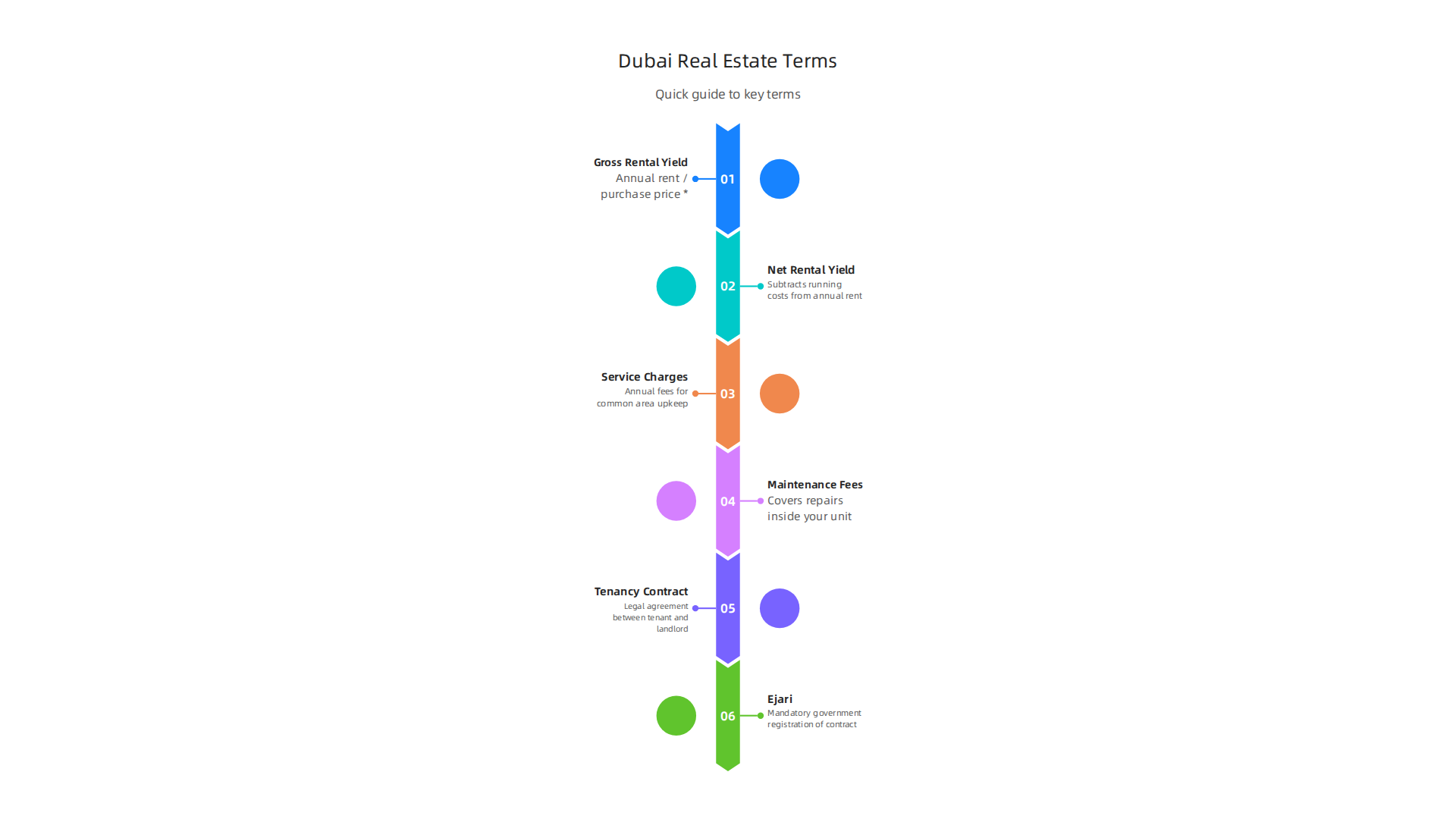
These terms help you compare properties honestly and avoid costly surprises.
Let us start with gross rental yield. This is the simplest way to see how much income a property might produce. You calculate it by dividing the annual rent by the property purchase price and multiplying by 100. For example, if you buy a flat for AED 1,000,000 and rent it for AED 60,000 per year, your gross yield is 6%. This number gives you a quick snapshot, but it leaves out expenses. It is a good starting point, but not the full story. You can learn the exact gross rental yield formula to run the numbers yourself.
Now, net rental yield is the more realistic measure. It takes your annual rent and subtracts all the running costs like service charges, property management fees, and maintenance. Then you divide by the purchase price. The result is a truer picture of what you actually earn. In 2026, the average rental yields in Dubai for 2026 show apartments performing better than villas, with average net yields around 7.15% for apartments. Always ask for the net yield from the seller or agent.
Speaking of costs, service charges and maintenance fees are the two expenses that eat into your returns the most. Service charges are annual fees paid to the building owner’s association for things like security, cleaning, and common area upkeep. These can range from AED 10 to AED 30 per square foot depending on the community and building age. Maintenance fees cover repairs inside your unit. In Dubai, the landlord is usually responsible for major maintenance, but minor repairs often fall to the tenant. Never buy a property without checking the service charge history. A cheap purchase price can be wiped out by high annual fees.
If you plan to rent out your property, you also need to understand tenancy contracts and Ejari. The tenancy contract is the legal agreement between you and your tenant. Ejari is the mandatory government registration that makes that contract official. Without Ejari, you cannot set up DEWA or use the contract for legal purposes. It is a simple step but a critical one.
Mastering these terms puts you ahead of most buyers. They help you spot hidden costs and choose investments that actually deliver. For a deeper look at how to apply these numbers, check out this long term real estate investment strategy for Dubai 2026 that uses data to guide your choices.
If you want to put these concepts into action for your own situation, consider getting personalized help. Buying, selling, renting, or investing in Dubai? Connect with Ayaz Salman for an expert FREE Dubai Real Estate Consultation to discuss your goals.
Understanding Dubai’s Real Estate Regulatory Framework
Now that you understand the key numbers and terms, it is time to talk about who makes sure the whole system stays fair. Dubai’s real estate market does not run on trust alone. It is backed by two important bodies: the Dubai Land Department (DLD) and the Real Estate Regulatory Authority (RERA).
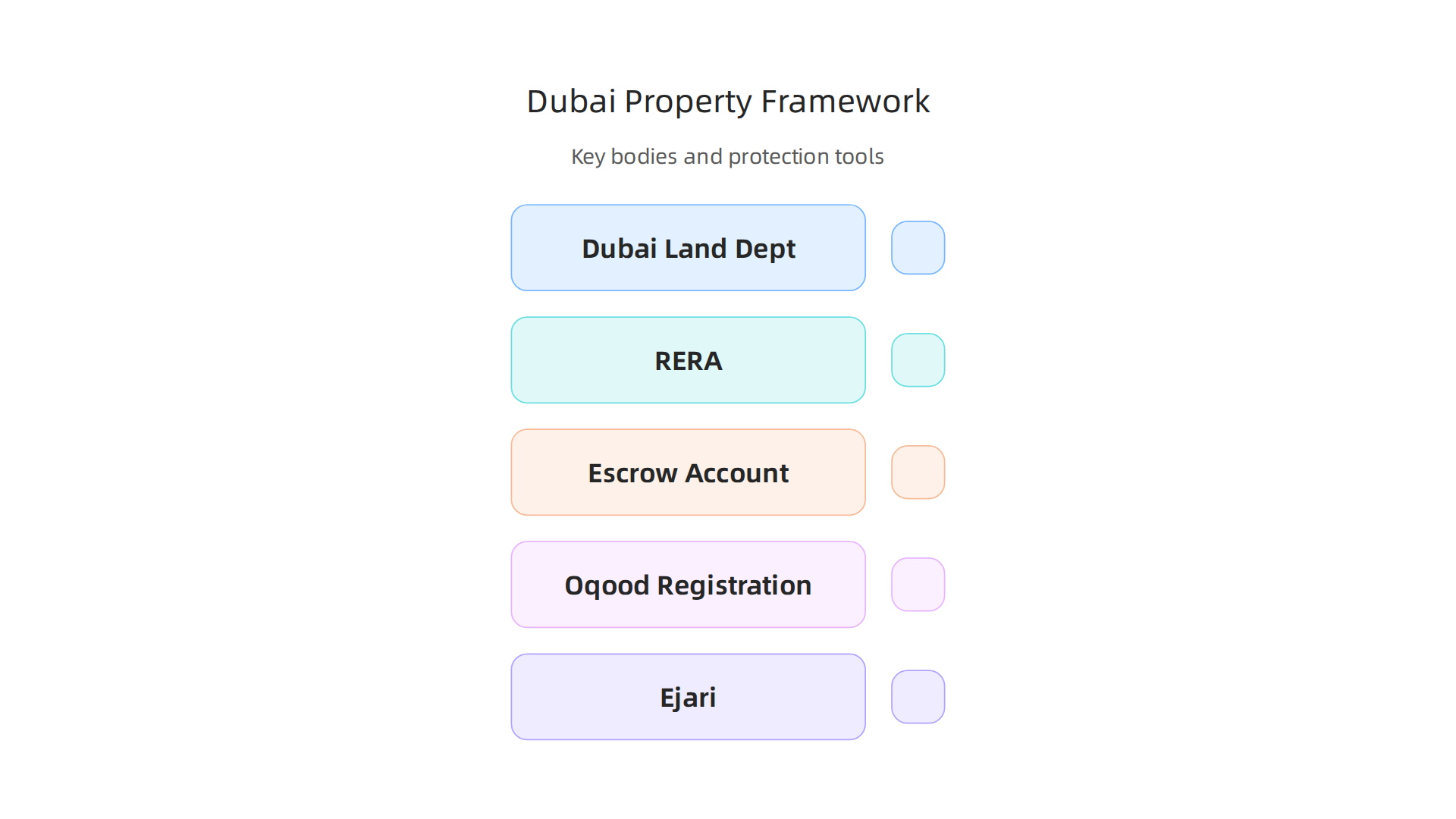
Knowing what is the real estate regulatory setup in Dubai will keep you safe from bad deals and scams.
The DLD is the main government agency that oversees all property transactions in the emirate. Think of it as the top office that registers properties, issues title deeds, and manages the overall market. RERA is its regulatory arm. This is the team that licenses developers, approves projects, and enforces the rules. Together, they create a transparent system that protects both buyers and investors.
One of the strongest tools they use is the escrow account system. If you are buying an off-plan property, your money must go into a special bank account that is controlled by RERA. The developer cannot touch those funds directly. Instead, the money is released in stages as construction hits specific milestones. A neutral engineer checks the work before any payment goes out. This stops developers from using your money for other projects or running away with it. It is a proven setup that has kept the market stable. For a detailed look at how this works, check out this article on how the UAE escrow law protects off-plan property buyers.
Another key step is Oqood registration. Once you sign a Sale and Purchase Agreement (SPA) for an off-plan unit, the developer must register it with the DLD through the Oqood system. This gives you an early legal claim to the property. It also helps you track the project’s progress. And for rentals, Ejari is the mandatory system that registers your tenancy contract with the government. Without Ejari, your rental agreement is not official.
Why does all this matter? Because a real estate deal that does not follow these rules is a red flag. If a developer asks you to pay outside an escrow account, walk away. If a property is not registered with the DLD, do not sign anything. The system is designed to protect you, but only if you check.
If you are ready to put this knowledge to work, you can also read more about how to verify real estate companies in Dubai to make sure you are dealing with the right people.
And if you want personal help navigating the rules or finding a safe property, reach out directly. Buying, selling, renting, or investing in Dubai? Connect with Ayaz Salman for an expert FREE Dubai Real Estate Consultation to discuss your goals.
The Buying Process in Dubai: A Step-by-Step Guide
Now that you understand the rules and who enforces them, let’s walk through the actual buying process.
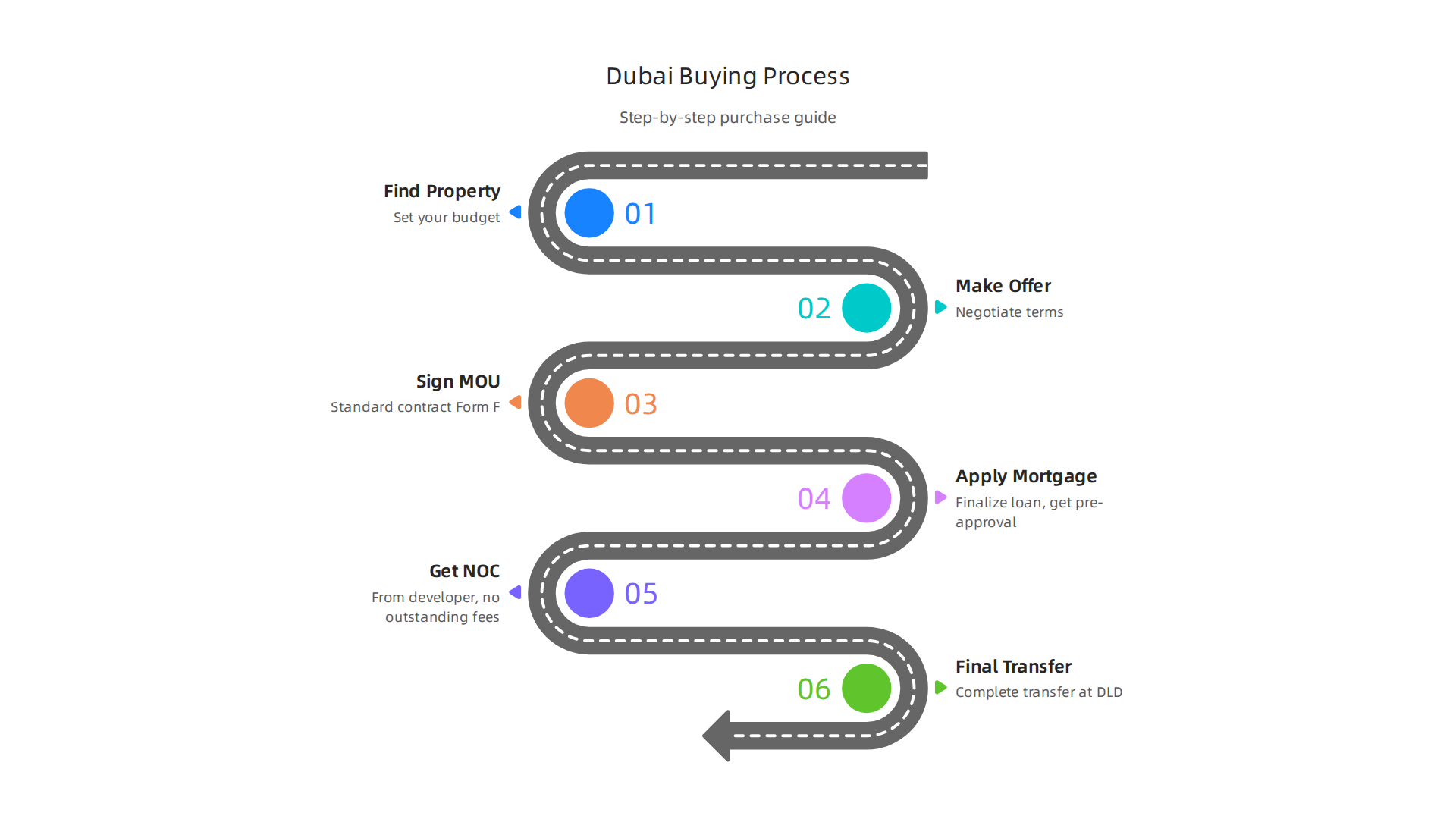
Whether you are buying a ready home or an off-plan unit, the steps are clear and straightforward if you follow them closely.
Step 1: Find Your Property and Set Your Budget
Start by figuring out how much you can truly afford. Remember to include upfront costs like the deposit, agent fees, and government charges. If you need a loan, get mortgage pre-approval early. This saves time later. Browse listings in trusted portals or work with a licensed agent. Check neighborhoods, compare prices, and look at recent sales in the area.
Step 2: Make an Offer and Negotiate
Once you find a property you like, submit an offer to the seller. Negotiate the price, payment timeline, and any conditions. If both sides agree, you move to the next step. For a detailed breakdown of what happens next, see this guide on the legal procedures to buy property in Dubai.
Step 3: Sign the Memorandum of Understanding (Form F)
This is a key document. The MOU, also called Form F, is a standard contract from the Dubai Land Department. It spells out the purchase price, payment schedule, and handover date. Both buyer and seller sign it in front of a witness, usually at a Registration Trustee’s office. At this point, you pay a security deposit, typically 10% of the price. This deposit is held by the trustee and goes toward the final payment. Never pay the deposit directly to the seller.
Step 4: Apply for a Mortgage (If Needed)
If you are financing the purchase, now is when you finalize your loan. The bank will ask for the signed MOU, your identification, and proof of income. They may also request a property valuation report to confirm the market value. Once approved, the bank issues a loan offer. You then sign the mortgage agreement.
Step 5: Get the No Objection Certificate (NOC)
The seller must get a No Objection Certificate from the developer. This document confirms that all service charges and maintenance fees are paid and that the property can be transferred. Both parties, along with the agent, go to the developer’s office to apply. The NOC usually takes a few days to issue.
Step 6: Final Transfer at the Dubai Land Department
This is the last step. Both parties meet at a DLD trustee office or service center. You bring:
- The original signed MOU (Form F)
- The NOC from the developer
- Valid IDs (passport, Emirates ID if resident)
- A cheque for the remaining balance (payable to the seller)
- A bank cheque for the 4% DLD transfer fee plus any admin fees (typically AED 4,000–5,000 for properties under AED 500,000)
The trustee verifies all documents, processes the payment, and issues a new title deed in your name. The whole transfer can be done in one day. You receive a confirmation by email.
A Few Extra Tips
- Always confirm the seller’s identity and ownership through the DLD’s online system.
- For off-plan purchases, ensure the project is registered and your payments go into the escrow account.
- Keep copies of every document you sign.
Before you begin, it is smart to know what could go wrong. Check out this list of UAE property purchase red flags to watch before buying in 2026 so you can avoid costly mistakes.
Understanding the buying process gives you confidence and keeps you safe. Now you know exactly what to expect and how to get your dream property in Dubai.
Rental Market Terminology and Legal Rights for Tenants and Landlords
To understand what is the real estate rental market in Dubai, you need to know the key terms and legal rules that protect both tenants and landlords. Whether you are renting your first apartment or managing a portfolio of properties, these basics will save you from costly surprises.
Essential terms you must know
-
Ejari – This Arabic word means “my rent.” Ejari is the official online system from the Dubai Land Department (DLD) that registers every tenancy contract. Without Ejari registration, your contract is not legally recognized. You cannot activate DEWA (electricity and water) or renew your residence visa without it. For a clear breakdown of how the tenancy contract and Ejari work together, check out this guide on the Tenancy Contract vs Ejari Certificate.
-
RERA Rental Index – This index sets the maximum rent increase a landlord can apply when renewing a lease. It calculates the fair rent based on the property location, size, and condition. If your landlord tries to raise the rent above the index limit, you can dispute it.
-
Security deposit – Typically 5% of the annual rent for unfurnished properties. The landlord holds this money and must return it at the end of the lease, minus deductions for damages beyond normal wear and tear. The landlord needs to provide receipts for any deductions.
-
Agency fee – If you use a real estate agent to find a rental, you usually pay a commission of 5% of the annual rent plus VAT. This fee is paid once at the start.
-
Renewal policies – Standard leases in Dubai run 12 months. When renewing, the landlord must give you 90 days’ notice if they plan to increase the rent. The increase must follow the RERA Rental Index.
Your rights under Dubai tenancy law
Dubai’s rental market is governed by Law No. 26 of 2007 and its amendments. This law sets clear rights for both sides.
For tenants:
- The landlord must cover major maintenance like plumbing, air conditioning, and structural repairs, unless the contract says otherwise.
- The landlord cannot enter the property without 24 hours’ notice, except in emergencies.
- If the landlord fails to fix a serious problem, you can file a complaint with RERA and potentially reduce the rent or cancel the lease.
For landlords:
- You can evict a tenant for non-payment of rent, but you must first send a formal notice through the Rental Dispute Settlement Center.
- If you want to evict a tenant to sell the property or move in yourself, you must give 12 months’ notice.
- The tenant cannot sublet the property without your written approval.
How to resolve disputes
If you and your landlord or tenant disagree, do not go to court directly. Start with the Rental Dispute Settlement Center at RERA. They handle cases like rent increases, evictions, and contract violations. The process is fast and relatively inexpensive. Many cases are resolved within a few weeks.
One more thing about rent increases
The RERA Rental Index is updated regularly. You can check the current index online to see if your proposed rent hike is legal. If the index says the maximum increase is 5%, your landlord cannot ask for 10%. Knowing this protects your budget.
Understanding the connection between dubai and real estate rental rules gives you confidence. Whether you are a tenant or a landlord, knowing the laws keeps the relationship fair.
If you need personalized advice about renting, buying, or investing in Dubai, do not guess. Get a FREE Dubai Real Estate Consultation with Ayaz Salman. He can help you understand the market and avoid costly mistakes.
For more insights on where the market is heading, read our guide on best ROI in Dubai for rental properties. It covers the latest trends in rental yields and off-plan opportunities.
Common Real Estate Investment Metrics Explained
Knowing the legal rules is one thing. But to make money in the Dubai market, you need to understand the numbers.

Investors use a few key metrics to judge whether a property is a good deal or a money pit. Here is what you need to know.
Rental yield is the most common starting point. It tells you how much annual rent you earn as a percentage of the property price. For example, if you buy a home for AED 1,000,000 and rent it for AED 60,000 per year, your gross rental yield is 6%. As of April 2026, the average rental yield in Dubai was 6.68%, with apartments averaging 7.15% and villas at 4.98%, according to the latest market report from Engel & Völkers.
But gross yield ignores costs. That is why net rental yield is more realistic. You subtract service charges, maintenance, property management fees, and vacancy periods from the rent before dividing. That gives you the real cash you keep. For a full walkthrough, check out this beginner’s guide to rental yield.
Cash-on-cash return is another metric smart investors use. Instead of looking at the full property price, it measures the return based on the actual cash you invested. If you put AED 200,000 as a down payment and get AED 20,000 in net income each year, your cash-on-cash return is 10%. This is especially useful when you use a mortgage.
Capital appreciation is the increase in the property value over time. In Dubai, some areas have seen strong price gains in recent years. But appreciation is not guaranteed. That is why you should always pair it with rental income to get a full picture of your total return.
Internal Rate of Return (IRR) is a more complex metric that accounts for the timing of cash flows. It tells you the annualized return over the entire holding period, including both rental income and the final sale profit. Most beginner investors do not need IRR, but it helps when comparing long-term projects.
Now here is the Dubai twist. Off-plan properties often come with payment plans that spread the cost over construction. That can boost your cash-on-cash return because you pay less upfront. But you also carry the risk of delays or market drops. Always factor in your exit strategy before buying off-plan.
Understanding these metrics helps you compare opportunities without emotions. If you want a deeper look at which Dubai neighborhoods offer the best returns, read our guide on best returns on investments Dubai 2026 property guide.
The connection between dubai and real estate investment metrics is simple: the more you understand the numbers, the safer your money is.
Ready to run your own numbers? Get a FREE Dubai Real Estate Consultation with Ayaz Salman. He can help you calculate realistic returns and find properties that match your goals. No pressure, just expert advice.
Summary
This guide explains how Dubai’s real estate market works in 2026 and gives you the practical vocabulary and steps needed to buy, rent, or invest with confidence. It covers ownership types (freehold vs leasehold), the difference between off‑plan and ready properties, the full buying process from offer to title transfer, and the regulatory protections provided by DLD and RERA, including escrow accounts and Oqood. You will also learn the financial metrics that matter—gross and net rental yield, cash‑on‑cash return, and capital appreciation—plus how service charges and tenancy rules affect returns. The article highlights tenant and landlord rights, the Ejari system, common pitfalls and red flags, and where to verify developers and agents. After reading, you’ll know what documents to request, how to run simple return calculations, which legal checks to perform, and when to seek expert help to avoid costly mistakes.